Scalp Cooling for Chemo Hair Loss: Automated vs. Manual
For oncology patients facing chemotherapy-induced hair loss, scalp cooling offers a real — if partial — defense. Here's the practical guide.
How It Works
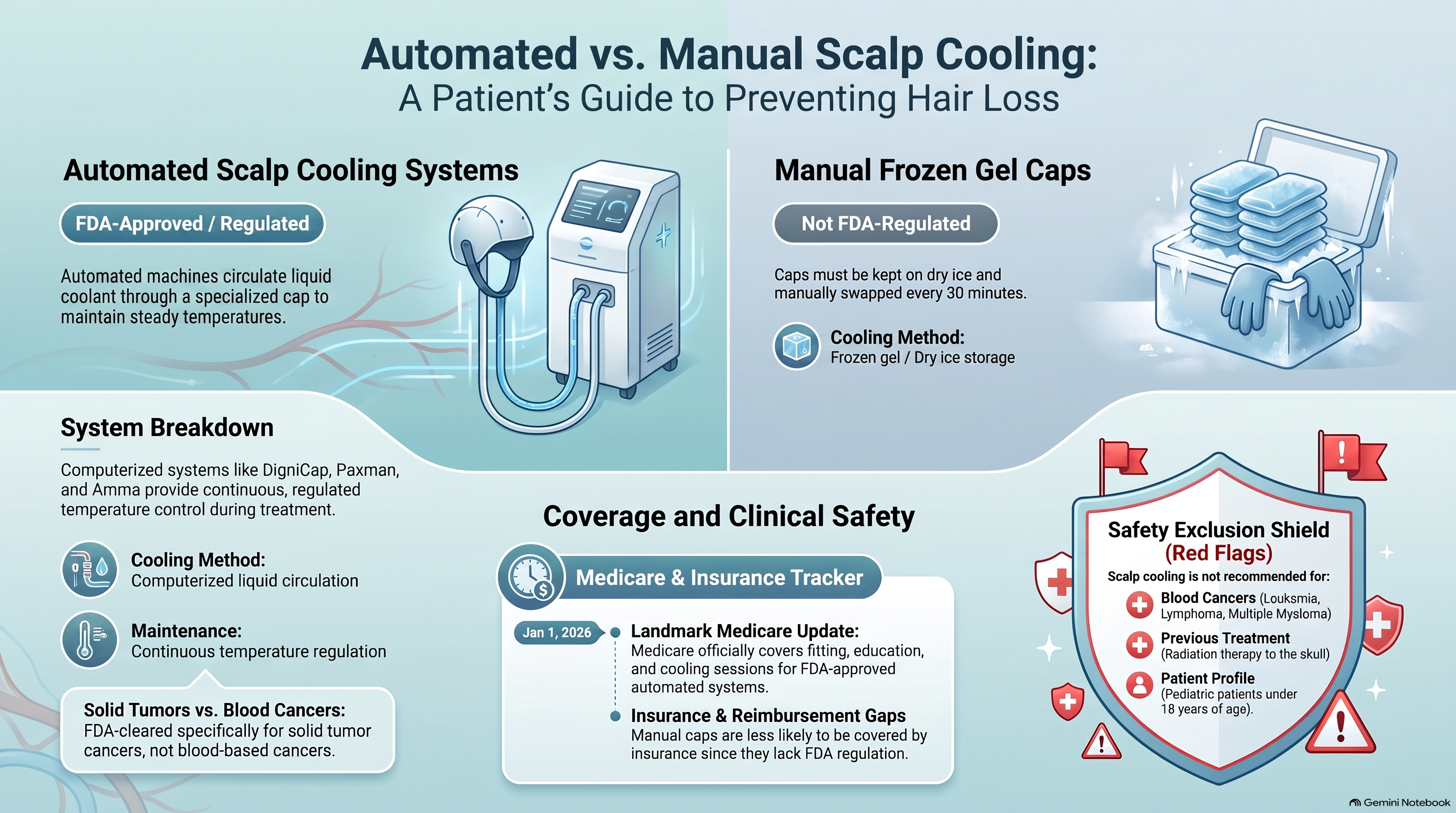
Scalp cooling constricts blood vessels in the scalp, reducing how much chemotherapy reaches the hair follicles, and lowers follicular metabolic activity. It's worn before, during, and after each infusion — and it's not for everyone: clinical exclusions include blood cancers and prior skull radiation.
The short version
- Scalp cooling constricts scalp blood vessels to reduce how much chemotherapy reaches the follicles and lowers follicular metabolic activity, and it is worn before, during, and after each infusion.
- Clinical exclusions rule out scalp cooling for people with blood cancers or prior skull radiation, regardless of which cooling system a center offers.
- Automated systems such as DigniCap, Paxman, and Amma are FDA-regulated machines that circulate liquid coolant through a cap held at a steady temperature for the whole session.
- Starting January 1, 2026, automated scalp cooling is covered under the Medicare Physician Fee Schedule, including cap fitting, patient education, and pre- and post-cooling.
- Manual frozen gel caps cost less upfront but are unregulated by the FDA, need freezing to far lower temperatures, and must be swapped for a fresh cap every 30 minutes.
- Financial aid for automated cooling is available through programs such as HairToStay and the Rapunzel treatment when a center or insurer does not cover it.
Automated Systems (DigniCap, Paxman, Amma)
FDA-regulated machines continuously circulate liquid coolant through a specialized cap at a steady temperature. The cap stays on the head for the entire session with no swapping. Starting January 1, 2026, automated scalp cooling is officially covered under the Medicare Physician Fee Schedule — including cap fitting, education, and pre/post cooling.
Manual Frozen Gel Caps
Inexpensive upfront, but unregulated by the FDA and logistically brutal: caps must be frozen to much lower starting temperatures (dry ice or deep freezers) and swapped for a fresh cap every 30 minutes throughout treatment. Coverage is highly unlikely.
Choosing
If you can access an automated system — through your oncology center, financial aid (HairToStay, the Rapunzel treatment), or the new Medicare coverage — it's the more reliable path. Manual caps work for some, but the temperature drift and swap discipline make results less consistent.
Get matched with hair restoration professionals →
Ready for a Professional Review?
We can connect you with qualified hair restoration professionals who can map your situation to the right treatment.
Get Matched with Hair Restoration Professionals