The Six Biological Threats That Kill Graft Survival
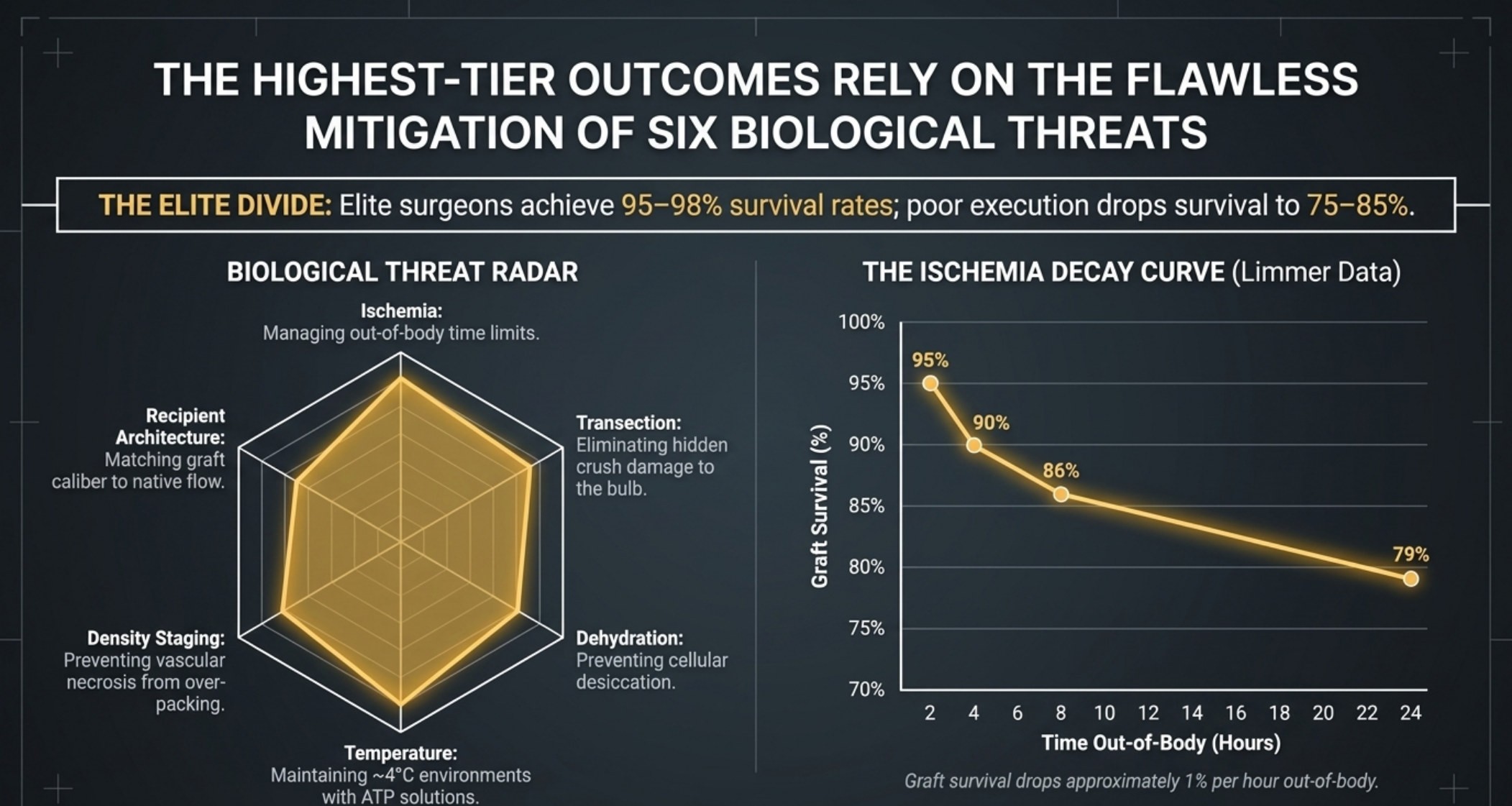
The difference between a hair transplant that looks full and one that looks sparse is not the surgeon's eye or the clinic's logo. It is process. Elite surgeons hold graft survival at 95-98%, while poor execution drops survival to 75-85% — a gap of up to 23 percentage points on the same patient, the same donor, and the same graft count. The entire gap is explained by how six biological threats are handled between the moment a follicle leaves the scalp and the moment it is seated again: ischemia, transection, recipient architecture, dehydration, density staging, and temperature. Every one of them is measurable, and every one of them is manageable. The verdict is blunt: ask a Frisco clinic how it manages out-of-body time and you have asked the only question that moves survival more than 20 points.
The Elite Divide Is a Time Problem
Graft survival drops approximately 1% per hour out of body. That single rate explains the whole 95-98% versus 75-85% spread. At 1% per hour, a follicle held for two hours loses roughly 2% survivability; hold the same follicle for eight hours and the loss compounds toward 8%. Multiply that by thousands of grafts and the arithmetic of a slow, disorganized session becomes visible on the scalp twelve months later.
The mechanism is ischemic injury. Once a graft is separated from its blood supply, its cells shift to anaerobic metabolism, and the mitochondria that will later need to drive follicular cycling begin to fail. The cooler the graft and the shorter the interval, the slower that failure runs. This is why elite outcomes are not a matter of surgical talent in the abstract but of logistics: how grafts are sorted, cooled, and staged so that time out of body never becomes the binding constraint.
The practical consequence is that throughput and quality are not opposites when the process is engineered. A practice that strictly caps volume can move quickly without letting grafts idle — the ISHRS benchmark for safe, elite practice is roughly 15 procedures per month, a schedule that keeps each session's graft handling inside a maintainable window.
| Benchmark | Figure | What drives it |
|---|---|---|
| Elite surgeon survival | 95-98% | Flawless mitigation of all six threats |
| Poor execution survival | 75-85% | Unmanaged out-of-body time and handling |
| Loss per hour out of body | ~1% | Ischemic decay of the follicle |
| Elite practice volume cap | ~15/month | Keeps handling time consistent |
The Six Threats and Their Countermeasures
Each threat attacks a different phase, which is why solving one does not protect against the others. Ischemia covers out-of-body time limits after excision. Transection is hidden crush damage to the bulb during extraction. Recipient architecture is the match between graft caliber and the native flow of surrounding hair. Dehydration is cellular desiccation in the holding medium. Density staging is over-packing that triggers vascular necrosis when too many grafts compete for the same blood supply. Temperature is the storage environment itself.
The threats overlap in a specific way: transection and dehydration both destroy a graft while it is still counting against your donor budget, and density staging destroys surrounding grafts that were never damaged at all. That is why over-packing is a self-defeating strategy — beyond the tissue's perfusion ceiling, additional grafts subtract from the ones already placed rather than adding density.
Recipient architecture is the least visible failure and the one patients notice most. A graft whose caliber is mismatched to its neighbors sits inline and catches light differently, producing the disconnected tufts that read as "pluggy" even when survival is technically high. Mating graft caliber to the native flow is a planning decision made before the first recipient site is created, not a correction available afterward.
| Threat | Mechanism | Countermeasure |
|---|---|---|
| Ischemia | Out-of-body time accumulates ischemic injury | Managing out-of-body time limits |
| Transection | Hidden crush damage to the bulb | Eliminating hidden crush damage |
| Recipient architecture | Caliber mismatch with native flow | Matching graft caliber to native flow |
| Dehydration | Cellular desiccation | Preventing cellular desiccation |
| Density staging | Vascular necrosis from over-packing | Preventing vascular necrosis from over-packing |
| Temperature | Warm storage accelerates decay | Maintaining ~4 degrees C with ATP solutions |
The Ischemia Decay Curve
The Limmer data plots graft survival against time out of body across a 2 to 24 hour window. The curve starts at 100%, holds in the mid-90s through the early hours, then bends downward as the interval lengthens, tracking through readings in the high 80s and low 80s before reaching the low 70s at the far end of the window. That shape — flat early, steepening late — is the reason scheduling matters more than speed alone.
Read against the ~1% per hour loss rate, the curve's two anchors are the operative numbers: a graft at 100% survivability at the start of its out-of-body interval and roughly 70-75% at the tail of a 24-hour window. The gap between an efficient session and a stalled one is the difference between living near the top of that curve and sliding down its steep section.
The countermeasures to ischemia are organizational rather than surgical. Shorter intervals between excision and placement, fewer grafts held in staging at once, and a team structure built so that no batch waits on a decision. Each hour saved is roughly 1% of survival preserved across the batch.
| Position on curve | Graft survival | Reading |
|---|---|---|
| Start of window | 100% | Graft newly excised |
| Early hours | 95% | Curve still nearly flat |
| Mid window | 85-86% | Decay becomes visible |
| Late window | 79-80% | Steepening slope |
| Far end of window | 75% / 70% | Approaching the poor-execution floor |
Temperature, Storage, and the ~4 Degree Standard
Cold slows the metabolic clock that ischemia is racing. The storage standard is an environment held near 4 degrees C, paired with ATP solutions that support the graft's energy state while its blood supply is absent. Warmer storage accelerates decay at the same ~1% per hour rate that governs out-of-body time; cold storage buys back time that handling errors otherwise waste.
Temperature also interacts with dehydration. Cold is protective only if the medium keeps cells hydrated; a chilled but desiccating environment damages the graft just as surely as a warm one. That is why holding solution and temperature are managed as a pair rather than as independent settings, and why a clean, covered, cooled staging tray is one of the most consequential pieces of equipment in the room.
None of these six threats is exotic, and none requires a novel technology to defeat. The gap between a 95-98% outcome and a 75-85% outcome is the presence or absence of disciplined process across a single day. Patients in Frisco can pressure-test those process controls with the full restoration slide deck and the treatment and graft tools before choosing a provider in Texas.
Why the Donor Budget Makes Survivability Financial
Survival is not only a cosmetic metric; it is a conservation metric. The permanent donor zone caps total lifetime supply at roughly 6,000 viable units, and the average first procedure consumes 2,347 grafts — about 35-40% of lifetime reserves in a single session. Every graft lost to ischemia or transection is a unit spent without producing hair.
Put the two ideas together and the economics tighten. A 10-point survival shortfall on a 2,347-graft session wastes roughly 235 follicles permanently, and that loss cannot be recovered by a later procedure because the donor bank does not refill. Managing the six threats is therefore how a patient protects the option of a second procedure years later.
This article is educational information, not medical advice, and a qualified provider should assess the individual case before any procedure is planned.
Frequently Asked Questions
What percentage of grafts survive a hair transplant?
Elite surgeons achieve 95-98% survival; poor execution drops to 75-85%. The 20-point-plus spread comes from how the six biological threats are managed, with survival falling roughly 1% per hour that grafts stay out of body.
How long can grafts stay outside the body before they die?
There is no safe plateau. The Limmer curve runs from 100% at the start of the out-of-body window down to roughly 70-75% at the far end of a 2 to 24 hour span, because survival drops about 1% per hour. Cold storage near 4 degrees C with ATP solutions slows that decay.
Why does over-packing grafts cause failure?
Density staging beyond the tissue's perfusion ceiling triggers vascular necrosis — too many grafts competing for the same blood supply, so added grafts subtract from the ones already placed rather than adding density.
Get matched with hair restoration professionals →
Ready for a Professional Review?
We can connect you with qualified hair restoration professionals who can map your situation to the right treatment.
Get Matched with Hair Restoration Professionals