Sapphire FUE vs DHI: How Delivery Systems Change the Hairline
Delivery is the one line item most patients never price, and it decides how a hairline ages. Two practices can quote the same graft count in Frisco and produce different hairlines, because the incision tool dictates how much lateral tissue is torn rather than sliced. Conventional steel blades cut a U-shaped channel that lifts surrounding tissue and raises trauma at every site. Sapphire FUE replaces steel with a synthetic single-crystal blade that carves precise V-shaped micro-channels. The DHI Choi pen runs a hollow mechanical needle that merges incision and graft placement into a single step. Compared against conventional steel, sapphire trial data reports 10-15% better graft survival and 30% less postoperative inflammation; DHI buys extreme control over exit angles for dense packing at a hard ceiling of roughly 3,500 grafts per session. The verdict: sapphire for high-volume sessions, DHI for small, angle-critical zones.
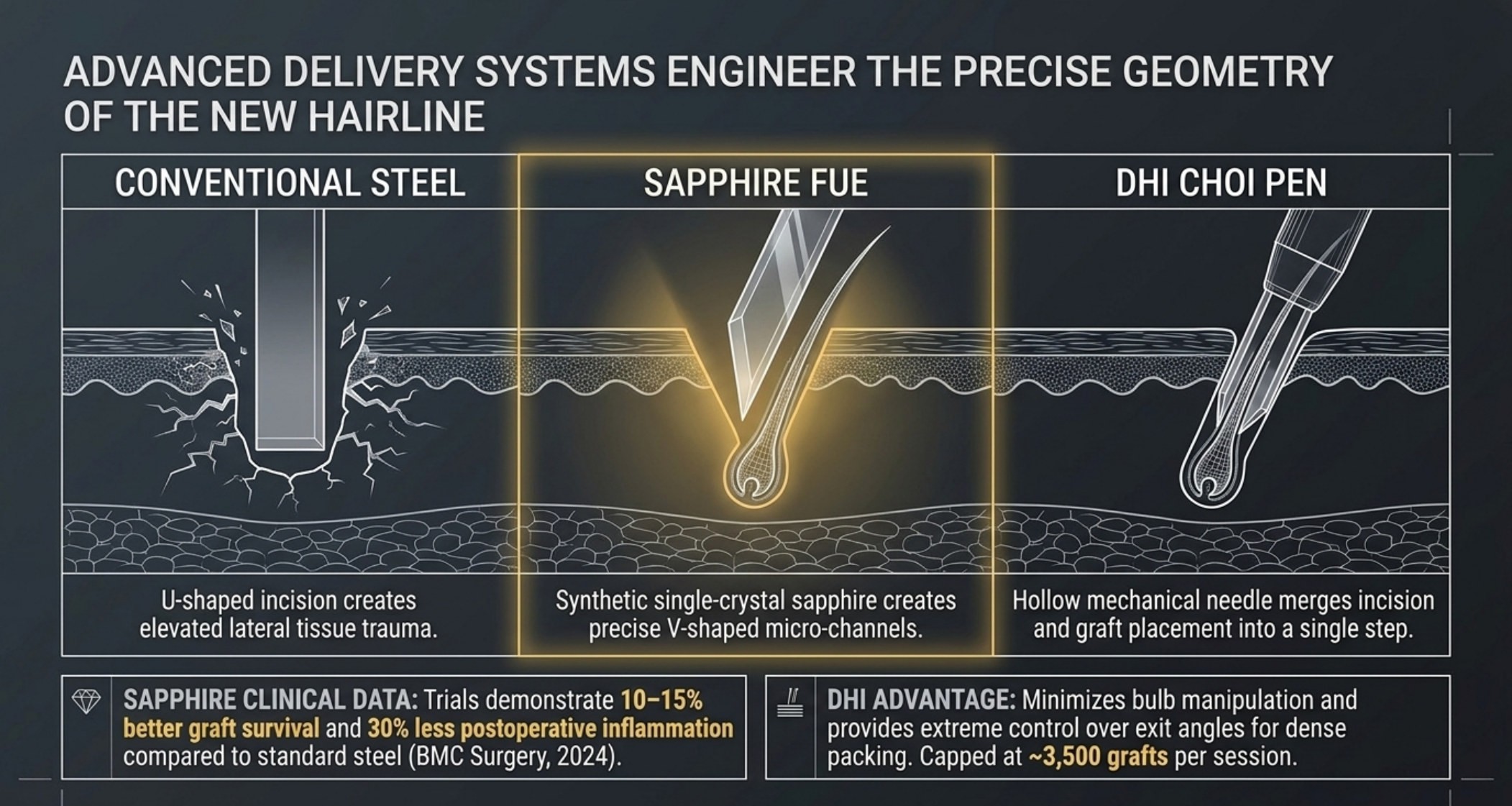
Incision Geometry: U-Shape, V-Channel, Hollow Needle
The three systems differ in exactly one mechanical property: how the blade displaces tissue at the moment of entry. A U-shaped steel incision lifts a small flap of lateral tissue, and that lifted tissue must then heal back down at every one of the hundreds or thousands of recipient sites a session creates. A V-shaped sapphire micro-channel parts tissue along a narrow taper, so the channel closes onto the graft with far less lateral disturbance. The Choi pen skips the two-step motion entirely: because the needle is hollow, the graft travels inside the same instrument that makes the channel, so the follicle is never released into open air between cut and place.
That mechanical difference compounds with scale. Every extracted follicle is a permanent withdrawal from a donor bank that cannot be replenished, capped at roughly 6,000 viable units for a lifetime, and the average first procedure already consumes 2,347 grafts. When a single poorly planned session withdraws 35-40% of lifetime reserves, the delivery tool stops being a preference and becomes a preservation decision. A tool that raises lateral trauma at each of those 2,347 sites multiplies the inflammatory load across the whole scalp.
The mechanism also explains why DHI producers market control rather than volume. Merging incision and placement means the operator can dial the exit angle of each graft independently, which is what creates the feathered, irregular forward edge of a natural hairline instead of a uniform row. The trade-off is throughput: a single-step hollow-needle pass is slower per graft than a fast V-channel rubric, which is why the DHI ceiling lands near 3,500 grafts while sapphire FUE can push larger megasessions with a separate placement step.
| System | Channel shape | Mechanical effect | Session ceiling |
|---|---|---|---|
| Conventional steel | U-shaped incision | Raised lateral tissue trauma | Not specified in data |
| Sapphire FUE | V-shaped micro-channel | Single-crystal sapphire parts tissue along a narrow taper | Supports megasessions |
| DHI Choi pen | Hollow needle | Incision and graft placement fused into one step | ~3,500 grafts per session |
The Sapphire Numbers: 10-15% Survival and 30% Less Inflammation
Sapphire's case rests on two trial figures and one material fact. The material is synthetic single-crystal sapphire, which holds a sharper, more consistent edge than reusable steel across a long session; a dulling blade tears rather than cuts, and torn tissue is where transection and inflammation begin. The trial figures are a 10-15% improvement in graft survival and a 30% reduction in postoperative inflammation versus conventional steel.
Those two percentages work on different timelines. The survival figure is what the patient sees twelve months later as density; the inflammation figure is what the patient feels in the first two weeks as swelling, redness, and recipient-site tenderness. A 30% cut in inflammation is also a compliance number: a calmer recipient zone is easier to keep clean, less likely to be scratched, and less likely to provoke the shedding panic that makes patients stop aftercare.
Scale the survival delta across a real session and it becomes grafts, not percentages. On a 2,347-graft first procedure, a 10-15% survival advantage is roughly 235-350 additional follicles that survive to grow, which is more density than most patients gain from an entire year of topical therapy. That is the strongest argument for treating the delivery tool as part of the clinical plan rather than a cosmetic upgrade.
| Metric | Sapphire advantage | What it changes for the patient |
|---|---|---|
| Graft survival | 10-15% better | Roughly 235-350 extra surviving follicles on a 2,347-graft session |
| Postoperative inflammation | 30% less | Calmer recipient zone, easier first-two-week aftercare |
| Channel profile | V-shaped micro-channel | Less lateral tissue displacement than a U-shaped incision |
Where DHI Wins, and Its 3,500-Graft Ceiling
DHI's advantage is not survival; it is geometry. Because the hollow needle places the graft as it cuts, the bulb is handled once at most, and bulb manipulation is one of the recognized threats to a follicle's viability. The same single-step control lets the operator set exit angles within a degree or two, which matters on the frontal hairline where a row of uniform angles reads as a plug line and a feathered scatter reads as natural hair.
The ceiling is explicit: ~3,500 grafts per session. That number is the practical hinge of the whole comparison. Below it, DHI can deliver dense packing with superior angle control. Above it, the session must either be staged into two or the delivery must shift to sapphire FUE, which separates incision from placement and moves faster per graft. A patient who needs 4,000 units cannot get all of them in one DHI sitting.
Volume requirements are matched to method by long-standing thresholds: FUE is the gold standard below 2,500 grafts, strip FUT is optimal for megasessions at 2,500 grafts and above, and hybrid approaches serve cases over 4,000 grafts. Read those next to DHI's 3,500 ceiling and the decision matrix becomes mechanical: DHI covers the under-2,500 zone where angle control matters most, sapphire FUE owns the 2,500-3,500 band, and anything beyond that needs staged or hybrid planning.
| Graft volume | Data-guided method | Trade-off to accept |
|---|---|---|
| Under 2,500 grafts | FUE gold standard; DHI for angle-critical zones | Lower volume, highest precision |
| 2,500 grafts and up | Sapphire FUE megasession; strip FUT also optimal | Strip needs 0.5+ inch hair to hide a linear closure |
| 3,500 grafts | DHI hard ceiling | Stage the second session or switch delivery |
| Over 4,000 grafts | Hybrid approach | Requires moderate to high scalp laxity |
Anatomy Decides Before Preference Does
Scalp laxity and FOX score override brand loyalty. A tight scalp makes a tension-free primary closure difficult, which pushes the decision toward FUT's zero-laxity requirement, while a high-laxity scalp opens both FUE and hybrid routes. FOX score models transection risk: FUE is customized per donor sub-zone, FUT is mandatory at FOX 1-3, and hybrid is clinically superior at FOX 4-5 precisely to prevent manual transection.
Hairstyle intent sets a third constraint. FUE supports a buzzed or faded cut because it leaves only scattered micro-dots; strip FUT requires at least 0.5 inch of hair to conceal its linear closure; hybrid needs moderate length to hide the strip scar. A patient who plans to keep a fade at 0.25 inch has already eliminated strip surgery, regardless of its graft economics.
Because delivery and donor limits interact this tightly, the practical next step is to model the numbers rather than argue the brands. Patients in Texas can pressure-test the volume thresholds with the graft planner and comparison tools and then read the clinical framework slide-by-slide before a single site is marked.
| Constraint | Threshold | Consequence |
|---|---|---|
| Lifetime donor supply | ~6,000 viable units | Every graft is a permanent withdrawal |
| Average first procedure | 2,347 grafts | Equals 35-40% of lifetime reserves in one session |
| Strip concealment | 0.5+ inch hair length | Ruled out for a buzzed cut |
| Hybrid laxity need | Moderate to high | Tight scalps cannot carry a 4,000+ graft hybrid |
What to Verify Before You Book
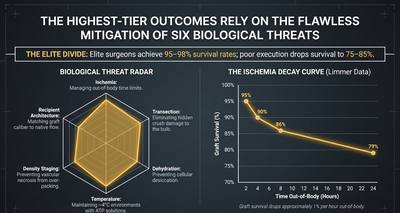
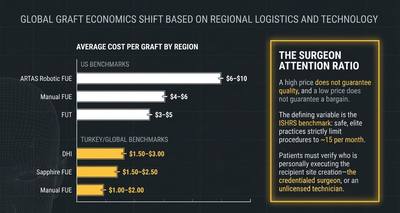
The delivery system on the invoice is not always the delivery system that touches your scalp. The operative question is who personally creates the recipient sites: the credentialed surgeon, or an unlicensed technician. Elite practices also cap volume at approximately 15 procedures per month, a schedule limit that keeps attention high and fatigue out of the final hour of a long session. A Frisco patient can ask those questions directly.
Ask for the tool by name, ask who holds it for the recipient phase, and ask how many sessions the practice runs per month. Those three answers separate a 10-15% survival advantage from a marketing slide. This article is educational information, not medical advice, and a qualified provider should assess the individual case before any procedure is planned.
Frequently Asked Questions
Does sapphire FUE really improve graft survival?
Trial data cited for the sapphire platform shows a 10-15% graft survival advantage and 30% less postoperative inflammation versus conventional steel. On a 2,347-graft first procedure that is roughly 235-350 additional surviving follicles.
Can I get more than 3,500 grafts with the DHI Choi pen?
No. DHI is capped at roughly 3,500 grafts per session because incision and placement happen in one step. Sessions above that ceiling are staged, or the delivery shifts to sapphire FUE, which supports the 2,500-graft-and-up megasession band.
Which delivery system leaves a visible scar?
FUE leaves only scattered micro-dots and supports a buzzed or faded cut; strip FUT requires at least 0.5 inch of hair to conceal its linear closure. Hybrid needs moderate hair length to cover the strip scar.
Get matched with hair restoration professionals →
Ready for a Professional Review?
We can connect you with qualified hair restoration professionals who can map your situation to the right treatment.
Get Matched with Hair Restoration Professionals