Cost Per Graft: US and Global Benchmarks Compared
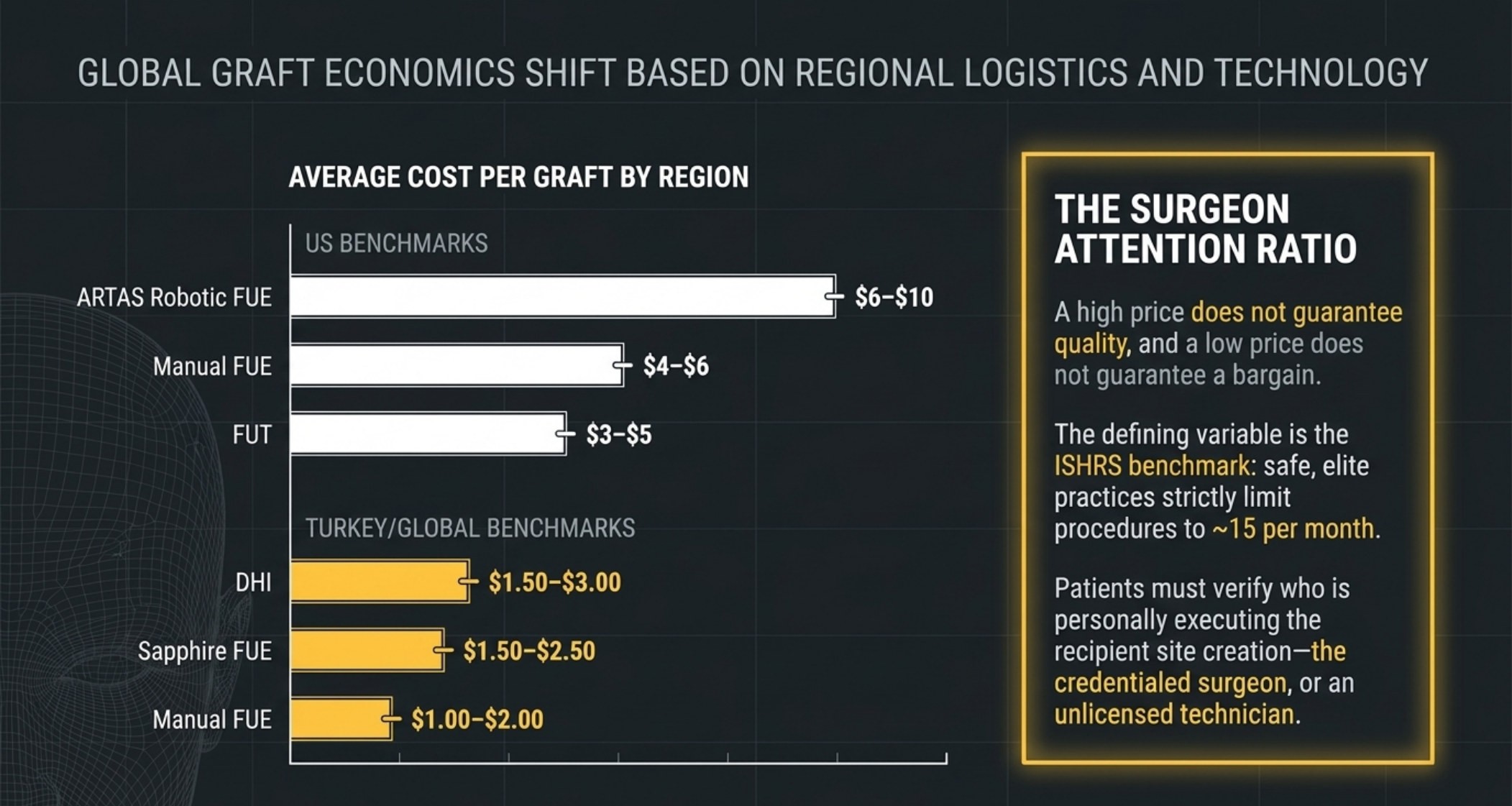
A hair transplant quote means nothing until it is divided by graft count, because the per-graft rate is the only honest unit of comparison. US benchmarks run $6-$10 per graft for ARTAS robotic FUE, $4-$6 for manual FUE, and $3-$5 for strip FUT. Turkey and other global benchmarks sit far lower on paper: $1.50-$3.00 for DHI, $1.50-$2.50 for Sapphire FUE, and $1.00-$2.00 for manual FUE. The verdict is not "fly abroad and save" and it is not "pay premium and relax." It is that a high price does not guarantee quality and a low price does not guarantee a bargain; the defining variable is process, and the benchmark that matters is whether a practice limits itself to roughly 15 procedures per month.
Why the Per-Graft Rate Is the Only Comparable Price
Total quotes hide three variables: graft count, delivery method, and who performs the recipient-site work. Converting every quote to a per-graft rate collapses the first two. A clinic charging $6-$10 under the ARTAS robotic FUE band is pricing the machine's cost per graft, not necessarily a superior outcome; the same patient on the $4-$6 manual FUE band may receive identical graft counts at a materially lower rate.
Strip FUT's $3-$5 band is the lowest US rate, and it is lower for a structural reason rather than a quality reason: strip extraction harvests many grafts from a single excision, so the per-graft labor is lower than the hundreds of individual FUE punches required to reach the same count. The trade-off is the linear scar, which needs at least 0.5 inch of hair to conceal — a real cost that never appears on the quote.
Because the average first procedure consumes 2,347 grafts, the rate you accept multiplies across a large base. A $1 difference per graft is roughly $2,347 on that single session, and the same patient has a lifetime donor bank of only about 6,000 viable units, so the rate applies to a finite and irreplaceable quantity.
| Method | Cost per graft | Why the rate sits there |
|---|---|---|
| ARTAS robotic FUE | $6-$10 | Equipment cost baked into each graft |
| Manual FUE | $4-$6 | One punch per graft, individual handling |
| FUT (strip) | $3-$5 | Many grafts from one excision, lower labor per graft |
What a 2,347-Graft First Procedure Costs at Each Rate
Multiply the published rate ranges by the average first-procedure graft count and the regional spread becomes concrete. At US manual FUE rates of $4-$6, a 2,347-graft session lands between roughly $9,388 and $14,082. The same graft count on strip FUT at $3-$5 lands near $7,041 to $11,735, while the ARTAS band of $6-$10 reaches roughly $14,082 to $23,470.
The global bands compress those totals dramatically. The same 2,347 grafts at $1-$2 manual FUE comes to roughly $2,347-$4,694; at $1.50-$2.50 Sapphire FUE it is about $3,520-$5,867; and at $1.50-$3.00 DHI it is roughly $3,520-$7,041. Anyone comparing a quote should run this multiplication before comparing anything else, because the answer changes by a factor of five across regions.
The catch is that the rate captures only the surgical line. Travel, lodging, a second trip for follow-up, and the practical difficulty of returning to the same operator for a touch-up all sit outside the per-graft figure, and none of them show up when the only number on the page is dollars per graft.
| Method and region | Cost per graft | Approx. total at 2,347 grafts |
|---|---|---|
| US ARTAS robotic FUE | $6-$10 | ~$14,082-$23,470 |
| US manual FUE | $4-$6 | ~$9,388-$14,082 |
| US FUT (strip) | $3-$5 | ~$7,041-$11,735 |
| Global DHI | $1.50-$3.00 | ~$3,520-$7,041 |
| Global Sapphire FUE | $1.50-$2.50 | ~$3,520-$5,867 |
| Global manual FUE | $1.00-$2.00 | ~$2,347-$4,694 |
What the Global Gap Buys and What It Costs
The global price advantage is real and structural, driven by regional logistics and technology rather than by some hidden trick. Lower operating costs and different market competition push DHI to $1.50-$3.00 and Sapphire FUE to $1.50-$2.50 in Turkey and comparable global markets, against $4-$6 for manual FUE in the US.
The exchange rate of that discount is measured in follow-up. Hair restoration is not a one-time event: grafts evolve over months, and when a session needs refinement, the patient who flew abroad faces a second trip at full cost, while the local patient drives in. That ongoing-access difference is the trade-off the per-graft rate silently omits.
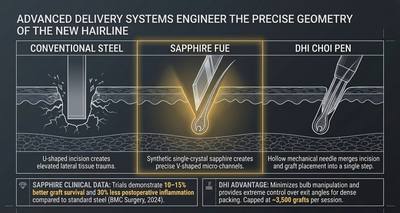
There is also a method constraint the global price does not remove. DHI, whatever its rate, is capped at roughly 3,500 grafts per session, and megasession territory begins at 2,500 grafts. A patient whose plan needs more than 3,500 units cannot buy a single-session solution at the lowest global DHI rate — the plan has to change, and with it the price math.
| Method | US benchmark | Turkey / global benchmark |
|---|---|---|
| Manual FUE | $4-$6 | $1.00-$2.00 |
| Sapphire FUE | Listed within the manual FUE US band | $1.50-$2.50 |
| DHI | Not separately benchmarked in US data | $1.50-$3.00 |
| FUT (strip) | $3-$5 | Not benchmarked in global data |
| ARTAS robotic FUE | $6-$10 | Not benchmarked in global data |
Price Does Not Track Quality: The Two Things to Verify
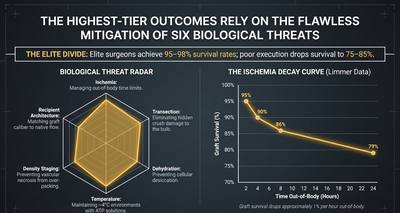
Two variables, not price, separate a good session from a bad one, and both are checkable in a single consultation. First, volume discipline: the ISHRS benchmark for safe, elite practice is roughly 15 procedures per month, a cap that keeps graft-handling windows tight and attention stable. A practice running far more is trading per-graft care for throughput regardless of its rate.
Second, and more consequential, is who personally creates the recipient sites — the credentialed surgeon, or an unlicensed technician. This is the line where a premium quote and a budget quote can produce identical outcomes, because the person holding the instrument determines the survival of every graft. A $9 per graft session staffed by an unlicensed technician can underperform a $4 per graft session performed end to end by the surgeon.
Neither answer appears on a price sheet. Both are questions a patient can ask directly, and the answers matter more than whether the quote came from a local clinic or from halfway around the world. Patients comparing options in Texas can pressure-test those answers against the cost guide and the regional cost breakdown, then verify volume and staffing with the graft and cost calculators.
How Frisco Patients Should Read a Quote
Frisco sits inside the US benchmark band, so a local quote should be divided by graft count and compared against the published ranges rather than against a single competitor's total. If the rate falls inside $4-$6 for manual FUE, the quote is consistent with the US benchmark; if it is far below, ask which variable was compressed.
Then run the two verification questions against the same quote: how many procedures does the practice perform per month, and who creates the recipient sites. A Frisco patient who gets a straight answer to both — and who multiplies the rate by a realistic 2,347-graft plan — has more pricing clarity than any comparison of headline totals can provide.
This article is educational information, not medical advice, and a qualified provider should assess the individual case before any procedure is planned.
Frequently Asked Questions
What is the average cost per graft in the US?
US benchmarks are $6-$10 for ARTAS robotic FUE, $4-$6 for manual FUE, and $3-$5 for FUT. On a 2,347-graft first procedure that ranges from roughly $7,041 at the low end of strip FUT to about $23,470 at the top of the ARTAS band.
Why is a hair transplant so much cheaper in Turkey?
Global bands run $1.50-$3.00 for DHI, $1.50-$2.50 for Sapphire FUE, and $1.00-$2.00 for manual FUE, reflecting regional logistics and technology costs. The trade-off is follow-up access: refinement or a second session means another trip, which the per-graft rate never shows.
Does paying more per graft mean better results?
No. A high price does not guarantee quality and a low price does not guarantee a bargain. The defining variables are whether the practice caps volume near 15 procedures per month and whether the credentialed surgeon — not an unlicensed technician — personally creates the recipient sites.
Get matched with hair restoration professionals →
Ready for a Professional Review?
We can connect you with qualified hair restoration professionals who can map your situation to the right treatment.
Get Matched with Hair Restoration Professionals